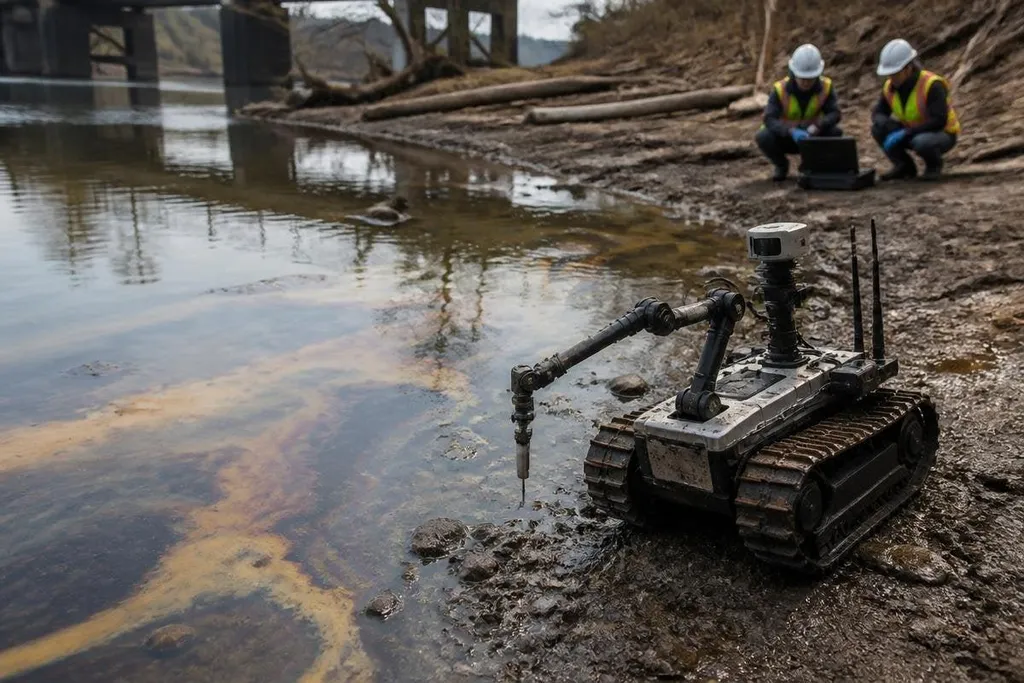
A robot can carry a camera, air sensor, water sampler, or radiation detector into places that may be unsafe for a person. Its first job is often to find and map pollution, while people still decide what the reading means and how cleanup should happen.
The useful question is practical: where can an environmental robot reduce exposure, collect better evidence, or reach a site that people cannot enter safely?
- Robots can inspect polluted air, water, soil, and industrial spaces.
- Sensor data is only useful when teams check its accuracy and location.
- Cleanup needs a separate plan for the waste, chemicals, or contaminated material.
Where robots can help
Environmental robots can move through a site while carrying sensors. A ground robot can inspect soil or waste areas, a drone can take images from above, and an underwater robot can check water or the seafloor. The right platform depends on the terrain and the pollutant.
A camera shows what a place looks like. A gas sensor can detect a substance in the air. A water sampler collects material for lab testing. These tools answer different questions, so a robot with several sensors still needs a clear sampling plan.
That plan matters because pollution can change over a short distance. A reading without a location, time, and sensor record gives a weak basis for action. Mapping software can place each reading on a site map, which helps a team return to the same area and check if conditions changed.
What the robot actually changes
The main gain is safer access. These systems can inspect a damaged pipe, flooded tunnel, chemical storage area, or waste site before a worker enters.
They can also repeat the same route, so a team can compare readings from one inspection to the next.
This work can reduce guesswork during the first survey. Field data may show where a plume begins, where water is moving, or which section of a site needs a closer sample. It cannot decide that a sensor reading is safe to ignore.
An ammonia reading from a river sample needs its location, time, and sensor beside it before a regulator can act. Reporting at Robot24.com can connect those details to the robot and field test, giving industry readers a record to inspect before the next section deals with messy data.
The hard part is the data
Sensors can drift, lose contact, or react to the wrong substance. Dust, water, heat, poor lighting, and blocked signals can also change what the robot records. A clean-looking map can still be wrong if the sensor was not checked against a known sample.
Teams need a record of the robot’s route, sensor settings, time stamps, and sample locations. They also need a way to check unusual readings. Lab analysis may still be needed before a regulator, site owner, or cleanup crew acts on the result.
Robot makers should state what their system detects, the range of each sensor, and the conditions that affect readings. A claim that a robot “finds pollution” is too broad without those details.
Cleanup is a separate machine problem
Finding pollution and removing it require different tools. A robot may locate contaminated soil, but another system must dig, contain, transport, or treat that material. Water cleanup can need pumps, filters, barriers, or chemical treatment, depending on what the sample shows.
Autonomy also has limits. The system may follow a route on its own, while a person handles sensor checks, safety decisions, sample labels, and unexpected obstacles. Remote control can help when the site changes faster than the robot can plan.
I’d fund the sensing step before the cleanup step. Better maps can guide the work, while an unproven cleanup robot may add cost and leave the main hazard in place.
A practical buying checklist
Before choosing an environmental robot, check these points:
- Name the pollutant. Confirm that the sensor can detect the substance you care about, rather than treating “environmental monitoring” as one task.
- Set the sample method. Decide if the job needs live sensor readings, physical samples, images, or all three.
- Check site access. Measure slopes, water depth, doors, debris, signal range, and any areas where a person cannot safely work.
- Plan verification. Set the lab tests or reference samples that will confirm unusual robot readings.
- Write the handoff. Decide who receives the data, who can stop the robot, and who acts on a dangerous result.
- Price the full job. Include training, sensor checks, batteries, data storage, maintenance, and the later cleanup work.
A robot earns its place when it gives the cleanup team safer access or better evidence at a cost the site can support. The next proof to ask for is simple: show the sensor record, the route, the sample check, and what changed after the result.